Nationwide delivery
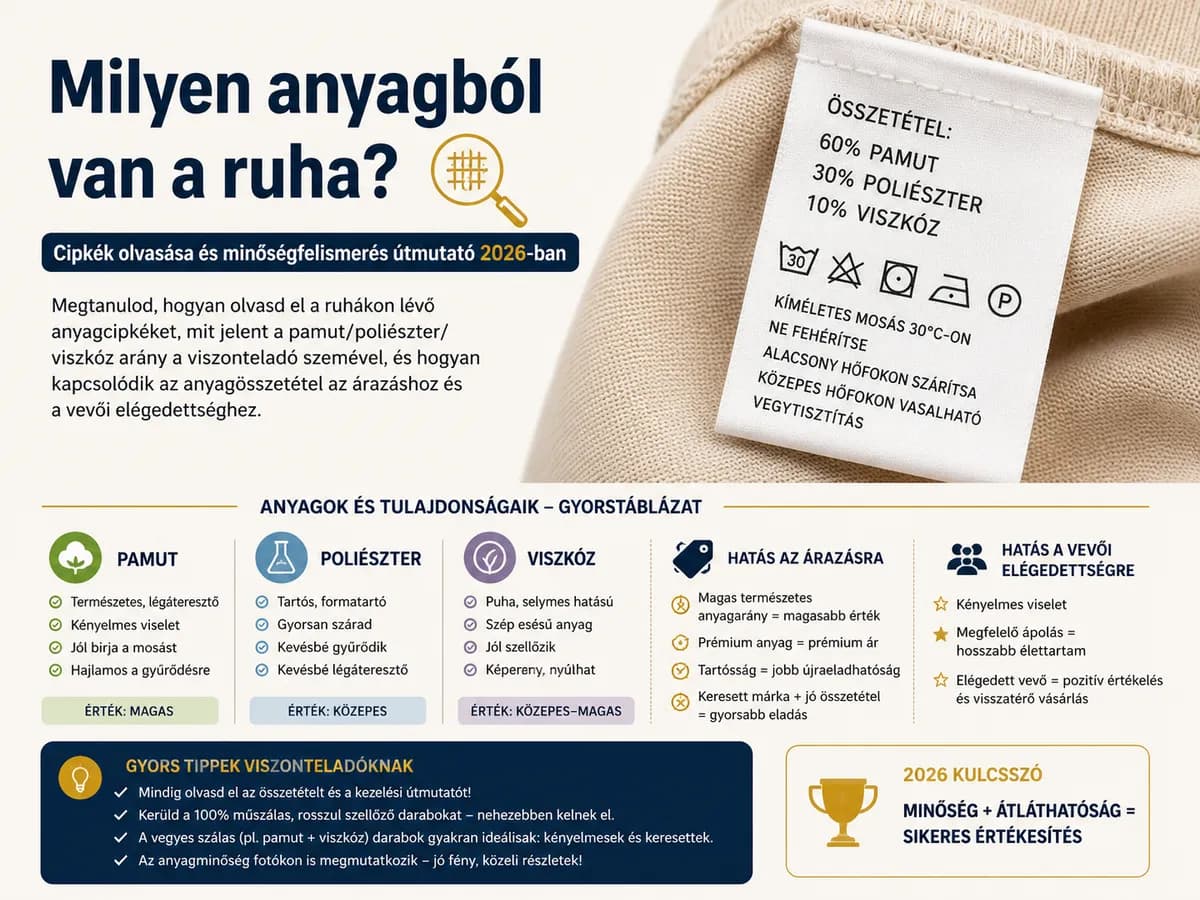
What Is This Garment Made Of? – Reading Care Labels and Identifying Fabric Quality in 2026
April 15, 2026

What Is This Garment Made Of? – Reading Care Labels and Identifying Fabric Quality in 2026

Extra Használtruha Team

Learn how to read the fabric composition labels on garments, what the cotton/polyester/viscose ratio means from a reseller's perspective, and how material content relates to pricing and customer satisfaction.

Quality Guide · April 2026

The label isn't decoration – it's your most important source of information

When you pick up a garment, the first instinct is to check its condition, the brand, and perhaps the size. Most beginner resellers stop there. Professional traders, however, always check one more thing: the inner label showing the fabric composition. That small, sometimes barely legible tag is where the most important information about the piece can be found.

The fabric determines how a garment wears, how it can be washed, how well it holds its shape, and – perhaps most importantly from a reseller's point of view – how much value it holds in the buyer's eyes. A 100% cotton T-shirt and a 100% polyester T-shirt represent entirely different categories, can be sold at entirely different price points, and attract entirely different types of buyers.

In this guide, we walk through all the key fabrics, show you how to read care labels, and explain why all of this matters for your business. If you'd like to go deeper into pricing, our pricing guide explains how fabric quality connects to your profit margins.

5 fabrics
The most common base materials in the secondhand clothing market
2–3×
Higher price achievable for cotton pieces compared to polyester
30 sec
All you need to read a fabric label once you know what to look for
100%
Natural fabric = premium positioning on Vinted

Who is this guide for?

For secondhand clothing resellers who sort and select stock and want to know which piece belongs to which price tier. Fabric knowledge is one of the best investments you can make with your time – a few hours of learning will significantly sharpen your pricing and boost customer satisfaction.

How to read a fabric label

Every garment sold in the EU is required by law to display its fabric composition. This is typically found on an inner label located at the neckline, the side seam, or the waist. The label lists the materials as percentages in descending order – meaning the first material listed is present in the greatest proportion.

What you'll find on the label
  • Fabric composition – e.g. "80% cotton, 20% polyester". The ratio tells you which material is dominant, and that's the basis for assessing value.
  • Care symbols – Symbols showing how the garment should be handled: whether it can be machine washed, at what temperature, whether it can be ironed, and whether it is dry-clean only.
  • Country of manufacture – "Made in…" text. It doesn't directly determine the price, but for certain branded pieces it serves as an authenticating factor.
  • Size – Some labels also include the size. If there is no separate size label, this is the only size information available.
What does the order mean?

If a label reads: "60% viscose, 35% polyamide, 5% elastane" – viscose is the dominant material. The first material listed typically defines the garment's feel, breathability, and value. That's why the quality of the first material is the most important factor when assessing a piece.

The 7 most important fabrics – what you need to know about each

The vast majority of secondhand garments on the market are made from six or seven base materials, or blends of them. Each has its own place and value – the key is knowing what to expect from each one.

Cotton
Premium value
The most valuable base material in the secondhand market. Natural, breathable, durable. On Vinted, the "100% cotton" label is a selling point in itself. It washes well, doesn't generate static, and is skin-friendly. Typical in quality T-shirts, denim wear, linen-style blazers, and shirt fabrics.
Polyester
Mid-to-low value
A synthetic fabric – cheaper than cotton, but durable and quick-drying. Its shiny surface is a telltale sign. Low breathability makes it less comfortable in summer. Common in sportswear and cheaper fast fashion pieces. Hard to sell at a premium price on Vinted.
Viscose / Rayon
Mid-range value
A semi-synthetic material with a natural base (cellulose). Silky to the touch, lightweight, with a great drape – which makes it popular in summer dresses and blouses. Sensitive to moisture and creasing. Its value sits between cotton and polyester. When in good condition, it sells easily.
Linen
Premium value
A natural, plant-based fabric – the best choice for summer wear, as it keeps you cool and breathes well. Characteristically slightly wrinkled in appearance – this is not a flaw, it's an inherent property of linen. Commands a high price on Vinted, especially for summer pieces. Always ask a premium price for it.
Wool
Seasonally high value
A natural, animal-based fabric – essential in winter coats, blazers, and cardigans. Highly sought after in autumn and winter due to its excellent heat retention. "Wool" or "Merino wool" on the label is a clear premium signal. Watch for moth holes and the degree of pilling.
Polyamide / Nylon
Lower value
A synthetic, strong, and elastic material. Typically found in hosiery, sportswear, lining layers, and windbreaker jackets. Less valuable on its own, but in blends (e.g. polyamide-cotton or polyamide-wool) it improves durability and drape. As a standalone fabric, it sells at a lower price point.
Elastane / Spandex
Supplementary material
Never used on its own – always appears in blends, at 2–15%. Its purpose is to provide stretch. If a pair of jeans contains 2% elastane, it means comfortable stretch. The value of the blend is not determined by the elastane, but by the dominant material.
Care symbols – what every reseller should know

Care symbols convey in pictogram form how a garment should be handled. Your buyers will regularly ask how a particular item can be washed – and if you don't know the symbols yourself, you won't be able to explain it convincingly. This has a direct impact on buyer trust and your ratings.

🪣
Tub symbol – washing
The number inside the tub (e.g. 30, 40, 60) indicates the maximum washing temperature. An X means it cannot be machine washed. A hand inside means hand wash only.
🔺
Triangle – bleaching
An empty triangle means bleach can be used. A diagonal line through it means only non-chlorine bleach is permitted. Two diagonal lines means bleaching is prohibited.
Square – drying
A square with a circle inside indicates tumble drying. The number of dots inside the circle indicates heat level (1 dot = low, 2 dots = medium). An X means tumble drying is not allowed.
♨️
Iron – ironing
The number of dots on the iron symbol indicates the maximum temperature: 1 dot = low (110°C), 2 dots = medium (150°C), 3 dots = high (200°C). An X means do not iron.
Circle – dry cleaning
A plain circle indicates the garment is dry-cleanable. The letters A, F, P, or W indicate the type of solvent to be used. A circle with an X means dry cleaning is not permitted.

Practical tip for resellers

When photographing a garment, also photograph the care label – this alone reduces the number of buyer questions and builds trust. If buyers can see from the photos that the item is machine washable at 40°C, they don't need to ask: their decision becomes that much easier.

Fabric and price – the direct connection

There is a direct relationship between fabric composition and selling price. This isn't a matter of opinion – market data from Vinted and Facebook consistently shows this. Resellers who consciously sort by fabric can price more accurately and can expect higher overall revenue.

Fabric-based pricing principles
Fabric Pricing tier Vinted average price (tops) Notes
100% cotton High 1,800–5,000 HUF "100% cotton" label = a selling point
Cotton-elastane blend High 1,500–4,000 HUF Stretch effect is a bonus
Linen High 2,000–6,000 HUF Seasonal: peaks in summer
Viscose / Lyocell Medium 1,200–3,000 HUF Popular in summer blouses
Polyester Low 500–1,800 HUF Sportswear can be an exception
Wool (winter piece) High (seasonal) 3,000–12,000 HUF Peaks in autumn and winter

The values in the table apply to unbranded pieces in good condition. If you'd like to do a deeper pricing calculation – including cost per kilogram and profit margin per item – read our pricing guide, where we walk through the calculation with real numerical examples.

Quality by touch – what the eye doesn't see

The fabric label informs you, but your hands tell you the truth. An experienced reseller knows from the first touch whether a piece is cotton or polyester, thick or thin, worn or in good shape. This knowledge can be acquired systematically.

How cotton feels

Cotton has a matte surface, a full, substantial feel, and doesn't generate static. If you rub your hand against it, it doesn't cling. The fabric doesn't shine – if it shines, there's a synthetic component. Well-washed but otherwise good-condition cotton is slightly softer than new – this is not a flaw, it's natural aging.

How polyester feels

Polyester is lighter than cotton, smoother, and shinier. If you twist it and let go, it quickly springs back – it has less tendency to crease. However, it doesn't breathe: press your finger against it and hold it there, and your hand warms up faster. On Vinted, buyers can usually tell the difference and will accept a lower price for it.

How wool feels

Real wool is slightly coarse and characteristically warm – if you touch it with your hand, your palm warms up quickly. It doesn't generate static and is springy: if you squeeze it and let go, it bounces back. It's important to check for moth holes and separating fibres – these are value-reducing factors that the fabric label won't reveal, but a visual inspection will.

Quick test

If you're unsure whether a fabric is cotton or polyester, pinch a corner of the fabric and hold it up to a strong light source (sunlight or a lamp). Cotton lets some light through but stays matte; polyester glitters and becomes noticeably brighter. If you see a two-toned shimmer, you're looking at a blend.

Fabric knowledge and the category system

In the extrahasznaltruha.hu quality category system (Cream, Extra, A+, Original), fabric composition is a defining factor. If you'd like to learn more about the categories and the logic behind them, read our business launch guide, which explains the system in detail.

💎 Cream
Natural fabrics
100% cotton, linen, wool, silk – these are the base materials of the Cream category. A high polyester content generally disqualifies a piece from this group.
⭐ Extra
Blended, but high quality
60–80% cotton blends, quality viscose, pieces with a small proportion of polyamide. Condition matters at least as much as the fabric.
🔵 A+
Synthetic blends
Higher polyester content pieces, but in good condition. Functional sportswear, polyblend tops – clean but not premium fabric category.
📦 Original
Mixed fabrics
Original bales contain every type of fabric. The entire point of sorting is to assign each piece to the right category based on fabric and condition.

If you work with original bales, fabric knowledge is the foundation of sorting. The faster you can assess a piece's fabric, the more efficient your work – and the more accurate your pricing. Our Original category is designed for those who want to be involved in the sorting process.

The most common mistakes in fabric identification
  1. Pricing without a label. If someone has cut out the label – perhaps it was irritating or had worn away – don't overestimate the piece. Without a label, the fabric cannot be proven. Lower the price and note in the description that the care label is missing.
  2. Only looking at the first material, ignoring the blend. "60% cotton, 40% polyester" is not the same as 100% cotton. A 40% polyester content fundamentally changes the feel and the value. Don't treat it as a premium piece if the blend ratio indicates a high synthetic content.
  3. Confusing wool with acrylic. Acrylic (100% acrylic) can feel just as warm as wool, but is worth a fraction of the price. Always check the label before treating something as wool. Real wool will say "wool" on the label.
  4. The shine = quality myth. A shiny fabric does not mean premium – in fact, it often signals synthetic content. Real silk is indeed shiny, but its label will clearly state "silk" or "100% silk".
  5. Not photographing the label. Photographing the label for every single piece is time-consuming, but it's an investment. It increases buyer trust and your average rating, because buyers don't need to ask – they can see everything in the photos.
Frequently Asked Questions (FAQ)
Why does fabric composition matter for a reseller?
Fabric composition has a direct impact on the selling price, the target audience, and customer satisfaction. A 100% cotton T-shirt can fetch twice the price of a polyester one on Vinted – simply because buyers are looking for natural fabrics. Fabric knowledge is therefore a measurable financial advantage.
What should I do if there is no label on the garment?
Without a label, the fabric cannot be verified. You can estimate it by touch, but the listing description must state that "the care label is missing – fabric appears to be cotton-like based on feel". This is transparent communication and reduces buyer disputes. When setting the price, err on the side of caution and estimate conservatively.
What is the difference between viscose and lyocell?
Both are cellulose-based semi-synthetic materials – natural wood is processed into textile fibres. Lyocell (also known under the TENCEL brand name) is produced using a more advanced manufacturing process: it is more environmentally friendly and more durable than viscose. Conscious buyers on Vinted value lyocell pieces slightly higher. With both materials, handle with care during washing: neither tolerates heat well.
Does fabric matter for sportswear?
Yes, but the logic is different. For sportswear, polyester and polyamide are the expected materials – buyers are specifically looking for these because they dry quickly and are durable. Cotton sportswear generally doesn't sell well for athletic use. For name brands (Nike, Adidas, Under Armour), the brand value outweighs the fabric. Technical materials (e.g. Gore-Tex) represent a premium category.
What does "organic cotton" on the label mean?
Organic cotton is grown without pesticides or synthetic chemicals – this represents premium value for conscious buyers. If you see this on the label, highlight it in your description: "organic cotton" fabric. This is a particularly strong selling argument on Vinted for children's clothing and underwear.
How do I identify real silk?
Real silk's label will say "100% silk". It feels cool to the touch, is lustrous but not plasticky, and is extremely lightweight. The burn test (burning a single thread) also reveals it: silk burns in a hair-like manner and leaves a char residue. If in doubt, check the fabric label – it is the only reliable method.
What does "recycled polyester" on the label mean?
Recycled polyester is made from reclaimed plastic (e.g. PET bottles). As a reseller, this can be appealing to eco-conscious buyers – the sustainability angle is a genuine selling point. It can be priced similarly to regular polyester, but framing the listing around "sustainable fashion" makes for a more compelling approach.
What should you look for when sorting wool pieces?
For wool pieces, focus on three key factors: 1) Moth holes – small round holes in the fabric are value-reducing; 2) Degree of pilling – heavy pilling makes the fabric look worn; 3) Odour – wool pieces can absorb tobacco or damp smells. These can't always be removed by washing, and buyers are particularly sensitive to this. If any of these apply, lower the price and disclose it in the description.
How should you highlight the fabric in your Vinted listing?
Don't just write "cotton". Write: "100% cotton, breathable, skin-friendly fabric". For linen: "100% linen, cooling summer fabric". For wool: "60% wool, 40% acrylic – warm and durable coat". Describing the fabric also helps with keyword search, and buyers feel less uncertain – meaning they're less likely to haggle.
Is photographing the care label mandatory?
Not mandatory, but it's one of the best investments you can make. Listings where the care label is visible in the photos generate significantly fewer questions and receive higher ratings. If you don't have time for every piece, at least photograph the label on premium items – wool, linen, 100% cotton.
Summary – fabric knowledge is an investment

Reading fabric labels and identifying materials is not a complex science – but it needs to be approached systematically. A few hours of learning, handling and comparing a few dozen pieces is enough for you to automatically know the value of any piece simply by reading the label and feeling the fabric.

The 5 golden rules of fabric knowledge:

  • 1. Always check the label – A 30-second investment that directly improves the accuracy of your pricing.
  • 2. The first material is the most important – The order of percentages shows the dominant material, which determines the value.
  • 3. Natural > synthetic, but there are exceptions – For sportswear, polyester is expected, not a disadvantage. Context matters.
  • 4. Photograph the label for every piece – It reduces the number of questions, increases buyer trust, and improves your ratings.
  • 5. Include the fabric's benefits in the description – "Cotton" alone isn't enough. Write: "100% cotton, breathable, skin-friendly" – this drives sales.

If you're curious about our current stock – including the Original category where you can put this knowledge to work during sorting – browse our products. If you have any questions, don't hesitate to get in touch – we're happy to help you navigate the categories and fabrics.

Cookie Preferences

Our website uses cookies to improve your experience and for statistical purposes. You can choose which cookies you allow. Privacy Policy.

What Is This Garment Made Of? – Reading Care Labels and Identifying Fabric Quality in 2026 | Extra Second Hand Wholesale