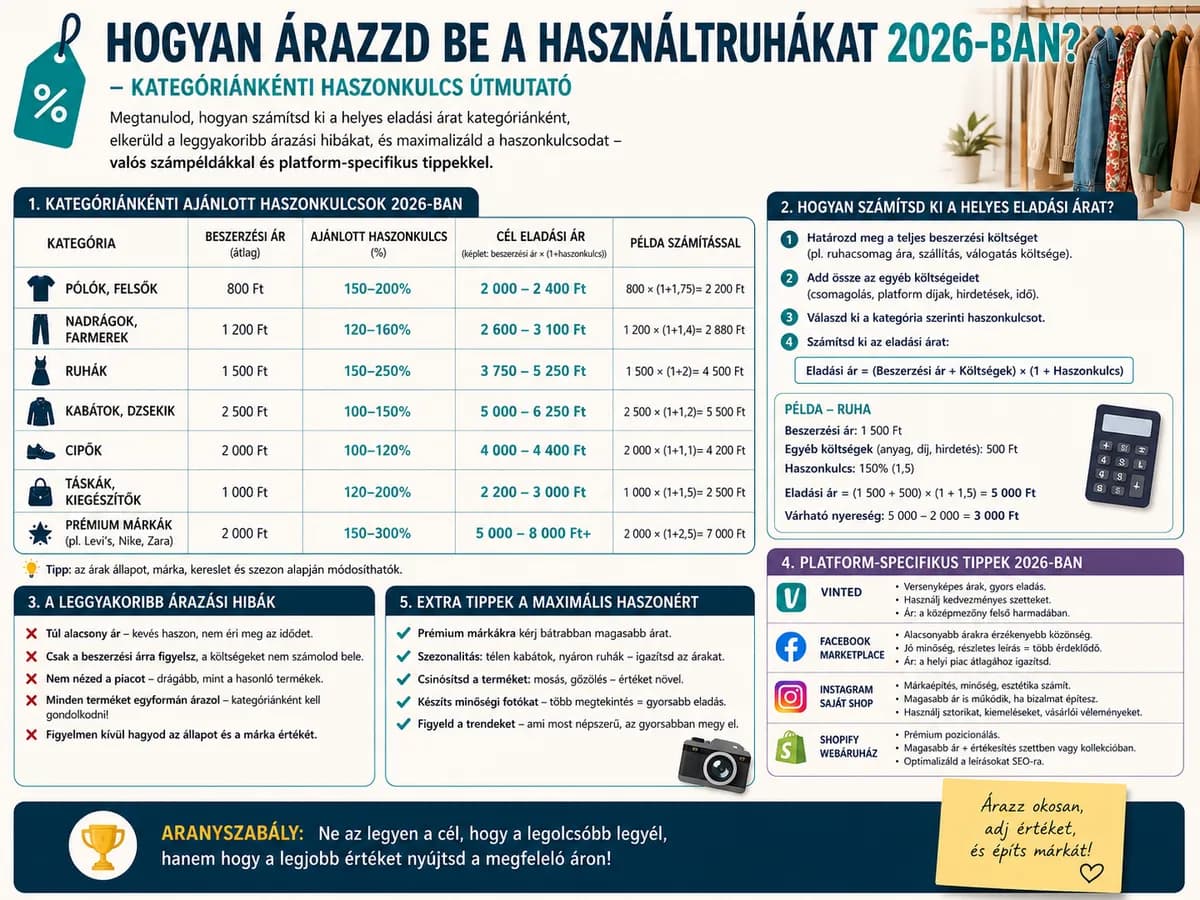
Introduction – Pricing Is the Most Expensive Lesson
Most beginner second-hand resellers oscillate between two extremes. One camp sells everything at half price just to "move stock" – and then wonders why there's nothing left in their pocket at the end of the month. The other camp lists items at unrealistically high prices, stares at the screen for three weeks, and then panics and dumps the whole lot below cost.
Correct pricing is not rocket science – but you need to know a few ground rules. You need to know how many pieces are in a kilogram, which platform tolerates which price range, and what hidden costs most resellers forget to factor in. Get those three things right and pricing becomes a routine.
In this article we walk through the calculation category by category, highlight the most common mistakes, and use real numerical examples to show what a profitable order actually looks like. If you haven't read our guide to quality categories yet, it's worth starting there – without that background the numbers will float in mid-air.
60–140%
Achievable margin in the Cream category
6–10 pcs
Typical number of tops per kilogram
3 platforms
Different price strategies needed for Vinted, Facebook, and market stall
5 hidden
Cost factors most resellers forget to calculate
Who is this guide for?
Beginner resellers who are still unsure about pricing; experienced traders who want to understand why they're not hitting their target margin; and anyone who wants to systematically plan their next order.
The Basic Logic of Pricing
The essence of pricing is simple: you need to know how much you paid for the goods and how much you can sell them for. The difference between those two figures is your gross margin – from which you still need to deduct hidden costs to arrive at your net profit.
The Core Formula
Calculation Formula
Unit cost = (kg × price/kg) ÷ number of pieces
Margin = (Selling price − Unit cost) ÷ Unit cost × 100%
Example: 20 kg Cream category at 2,600 HUF/kg = 52,000 HUF purchase cost. If 1 kg of tops contains 8 pieces, you received 160 items. Unit cost: 52,000 ÷ 160 = 325 HUF/pc. If you sell at 2,000 HUF, your margin is: (2,000 − 325) ÷ 325 × 100% = ~515%.
How Many Pieces Are in 1 kg?
This is one of the most important numbers you need to know – and it varies by category and product type:
👕 Tops (t-shirts, blouses)
6–10 pcs/kg
Lightest category, most pieces per kilogram
👖 Trousers, jeans
3–5 pcs/kg
Heavier fabric, fewer pieces
🧥 Coats, jackets
1–2 pcs/kg
Heaviest category – higher value per piece
👟 Shoes (pairs)
2–4 pairs/kg
Sold in pairs, weight varies by style
Category-by-Category Margin Table
The figures below are based on our real market experience – not theoretical estimates. Of course, the actual selling price always depends on the item's condition, brand, photos, and platform, but these are good starting points for your calculations.
| Category |
Purchase price |
Typical selling price/pc |
Margin |
Best platform |
| 💎 Cream |
2,400–3,000 HUF/kg |
2,000–8,000 HUF/pc |
60–140% |
Vinted, webshop |
| ⭐ Extra |
2,000–2,400 HUF/kg |
1,500–5,000 HUF/pc |
40–100% |
Vinted, Facebook |
| 🔵 A+ |
1,700–2,000 HUF/kg |
800–3,000 HUF/pc |
30–70% |
Facebook, market |
| 📦 Original |
1,400–1,700 HUF/kg |
Mixed after sorting |
Variable |
Own sorting operation |
💎 Cream – premium investment
Higher purchase price, but the per-item selling price is significantly higher too. A branded coat at 2,500 HUF/kg with 1–2 pcs/kg gives a unit cost of ~1,250–2,500 HUF. Sold on Vinted for 8,000–15,000 HUF: that's a 500–1,000% margin. Cream is not a volume product – it requires quality presentation, but it's worth it.
⭐ Extra – the best value-for-money
The most stable category. For t-shirts: 2,200 HUF/kg × 8 pcs/kg = 275 HUF/pc unit cost. If you sell for an average of 1,500 HUF on Facebook, your margin is around 445%. Extra is reliably fast-moving and predictable.
🔵 A+ – fast turnover, moderate margin
The strength of A+ is its turnover speed – it sells quickly and many buyers look for this price range. Trousers at 1,800 HUF/kg × 4 pcs/kg = 450 HUF/pc. If you sell for 1,200 HUF at a market stall: 167% margin. Lower margin, but less labour too.
Platform-Specific Pricing Strategy
The same garment sells at very different prices on different platforms. It's worth adjusting not just the price, but also the pricing approach for each platform.
Vinted – Higher Base Price, Negotiation Room Required
Vinted's audience is accustomed to bargaining. Price 10–15% higher than your minimum acceptable price – this leaves room for a discount without hurting your profit. If you'd accept 2,000 HUF for a t-shirt, list it at 2,300–2,400 HUF. The "10% offer accepted" message gives the buyer a good feeling and costs you nothing.
Competitor analysis on Vinted: Before pricing an item, search for the brand + type + size combination. Check how many similar listings there are, at what prices, and how long they've been listed. If someone has been listing for 3 weeks with no sale, your price should be lower – or your photo should be better.
Facebook Marketplace – Fast Turnover, Bundle Deals
Prices on Facebook are generally 20–30% lower than on Vinted – but there's no shipping packaging, no courier tracking, no waiting. In-person collection saves your time. A very effective tactic is the bundle deal: "3 items for 2,000 HUF" speeds up sales and increases the average basket value.
Market Stall – Per-Item Price vs. Per-Kilo Price
The best strategy at a market stall is grouping: offer items of similar category and quality at a single price point (e.g. all trousers 800 HUF, all coats 1,500 HUF). Simplicity speeds up sales and eliminates the headache of pricing each item individually. For a premium basket display, use a lower base price for volume; display nice branded pieces separately on a rail at a higher price.
💡 Platform comparison
A detailed platform comparison – which category performs best on which channel and how to combine them – can be found in our platform guide.
Hidden Costs – What Most People Forget to Factor In
A margin calculation is only accurate if you include every cost. Most beginner resellers only count the purchase price – and then wonder why the expected profit doesn't materialise.
- Shipping cost (when purchasing) – From the wholesaler to your warehouse. This is not zero: it's worth checking the delivery terms in advance and dividing the cost across the number of pieces.
- Packaging materials (for Vinted sales) – Bubble wrap, cardboard box, tape: 80–200 HUF per parcel. At high volume, this adds up.
- Cash on delivery (CoD) handling fee – If the buyer pays on delivery, the courier company charges a handling fee. This must be built into the selling price or charged separately.
- Your own labour time – Photography, writing descriptions, messaging, packing. If you calculate at an hourly rate, a single item can take 15–30 minutes. This can't be avoided, but it must be consciously factored in.
- Returns and leftover stock – Not every item will sell. You paid for the unsellable portion too – this must be built into the price of the sold items, or minimised with the Video Check guarantee.
- Market stall rent (if selling at a market) – A fixed daily cost that represents a loss until the first items are sold. Calculate how many pieces you need to sell to break even – this is your "breakeven point".
Seasonal Pricing – When to Raise Prices, When to Drop Them?
The second-hand market is not as seasonal as new fashion – but demand is not uniform. If you know the waves, you can sell at higher prices and won't need to panic-dump your stock.
🧥 Early autumn (September)
Demand for coats and jumpers spikes – you can raise prices by 20–30% compared to summer levels. Don't clear out your coat stock at half price in summer.
☀️ Late summer (August)
End-of-season clearance for summer items (dresses, t-shirts). Better to give a discount and free up space than carry it through to winter. Nobody is looking for summer clothes in February.
📐 The "2-week rule"
If an item hasn't sold at the original price within 2 weeks, reduce it by 10–15%. If it still sits after another week, reduce again – or move it to another platform.
7 Pricing Mistakes to Avoid
- No negotiation room in the price – If you list at your minimum right away, buyers will still negotiate and you'll have no room. Always price 10–15% higher.
- "Branded" pricing without a brand label – If the item has no readable brand label and you can't credibly prove the brand, premium pricing won't be accepted. Always photograph the label.
- Not checking competitors' prices – Pricing blindly is risky. Always check what others charge for the same item on the same platform.
- Not accounting for piece count – Someone who thinks in kilograms but sells by the piece can easily miscalculate. Know the piece count first, then price.
- Pricing every item the same – An H&M t-shirt is not worth the same as a Tommy Hilfiger shirt. Categorise and price differentially.
- Not including hidden costs – Shipping, packaging, labour – these all raise the real unit cost.
- Not managing stuck stock – If something has been sitting for 3–4 weeks, it's tying up capital. Better to drop the price and reinvest, than to maintain an unrealistic expectation of "it'll sell eventually".
Real Calculation Examples
Example 1: 20 kg Cream category – Vinted sales
PURCHASE COST
52,000 HUF
20 kg × 2,600 HUF/kg
PIECE COUNT
~150 pcs
Mix of tops + trousers
AVG. SELLING PRICE
2,500 HUF/pc
Vinted, incl. negotiations
GROSS REVENUE
375,000 HUF
150 pcs × 2,500 HUF
MARGIN
~621%
Before hidden costs
Example 2: 30 kg Extra category – Facebook + flea market mix
PURCHASE COST
66,000 HUF
30 kg × 2,200 HUF/kg
PIECE COUNT
~220 pcs
Mix of tops + trousers
AVG. SELLING PRICE
1,200 HUF/pc
Facebook + market
GROSS REVENUE
264,000 HUF
220 pcs × 1,200 HUF
MARGIN
~300%
Before hidden costs
✓ The logic behind the numbers
The Cream margin looks higher on paper, but selling on Vinted takes more work per item. The Extra category via Facebook+market gives a lower margin but far less effort. Neither Cream nor Extra is "better" – they suit different business models. In our current stock both categories are available.
Frequently Asked Questions (FAQ)
How do I calculate my profit margin?
Margin = (Selling price − Unit cost) ÷ Unit cost × 100%. Unit cost = total purchase cost ÷ number of pieces. Important: also add hidden costs (shipping, packaging, labour) to the unit cost for an accurate picture.
How much does one Cream category garment cost on average?
It depends on the product type. For tops (6–10 pcs/kg, 2,600 HUF/kg): ~260–433 HUF/pc. For coats (1–2 pcs/kg, 2,800 HUF/kg): ~1,400–2,800 HUF/pc. Coats cost more per piece but also sell for much more.
Should I go below cost if something won't sell?
Yes, but gradually. Apply the "2-week rule": after 2 weeks reduce by 10–15%, after another week reduce again. If it still won't move, transfer it to another platform (e.g. from Vinted to Facebook) or offer it as part of a bundle. Storing unsold stock ties up capital – turnover matters more.
How do I price items sorted from an Original bale?
After sorting, price by category: better pieces go to Vinted at Extra pricing, mid-range pieces go to Facebook at A+ pricing. The Original bale's lower average purchase price (~1,500 HUF/kg) means sorted items can have a potentially high margin. Browse our
Original stock.
Is the selling price higher on Vinted or Facebook?
Generally 30–50% higher on Vinted for the same item – but it involves more work (photos, description, packaging, courier). Facebook is faster-moving with less admin, but lower per-unit price. It's worth using both platforms simultaneously: Vinted for premium pieces, Facebook for fast turnover.
What should I do with stuck stock?
Four options: 1) Lower the price by 10–20%. 2) Transfer to another platform. 3) Bundle with other items. 4) Take it to a flea market where you can sell in bulk. Stuck stock is the most expensive thing in reselling – it ties up capital and space.
Do I need to charge VAT?
This depends on the form and turnover of your business. Businesses below the VAT exemption threshold (12 million HUF/year in Hungary) do not need to charge VAT. Above this, VAT is mandatory. Occasional private sales may be exempt – but regular commercial activity requires tax registration. Always consult an accountant on tax matters.
How do I track competitors' prices?
On Vinted: search for the same brand + product type + size and check the active listings. Note how long each item has been listed – if it's been up a long time, the price is probably too high. On Facebook: search seller listings in local groups. Once a week is sufficient – prices change slowly.
When is it worth running a sale?
It's worth running a sale 3–4 weeks before the end of season to avoid being left holding stock. The "weekend sale" method works well: everything 20% off from Friday to Sunday. It's also worth clearing space before new stock arrives – the sale shifts existing items and frees up cash for fresh orders. Keep an eye on our
current stock.
How do I calculate if I don't know the piece count in advance?
Use conservative estimates: 7 pcs/kg for t-shirts, 4 pcs/kg for trousers, 1.5 pcs/kg for coats. If reality is better, you gain – if worse, you won't have oversold your margin. The Video Check guarantee helps you see the composition of the goods in advance: you watch the video and can already estimate the piece count and quality. Contact us with any questions via our
contact page.
Summary – The 5 Golden Rules of Pricing
Pricing is not a one-time decision – it requires ongoing attention, learning, and fine-tuning. But if you follow these ground rules, you'll avoid most of the beginner mistakes.
The 5 golden rules of pricing:
- 1. Know your piece count – First assess how many items are in your stock, then price.
- 2. Factor in every hidden cost – Shipping, packaging, labour, waste. Don't start from the purchase price alone.
- 3. Leave negotiation room – Price 10–15% higher than your minimum. This is the cheapest "discount" you can give.
- 4. Different strategy per platform – Vinted: higher price + negotiation room. Facebook: fast turnover. Market: grouping and simplicity.
- 5. Keep stock moving – Stuck stock ties up capital. The "2-week rule" protects you from frozen inventory.
The foundation of successful pricing is a reliable, predictable purchase price. If you know what you're paying and can see the goods in advance (Video Check guarantee), your calculations will be far more accurate. Browse our current stock, or if you have questions about pricing by category – contact us, we're happy to help.