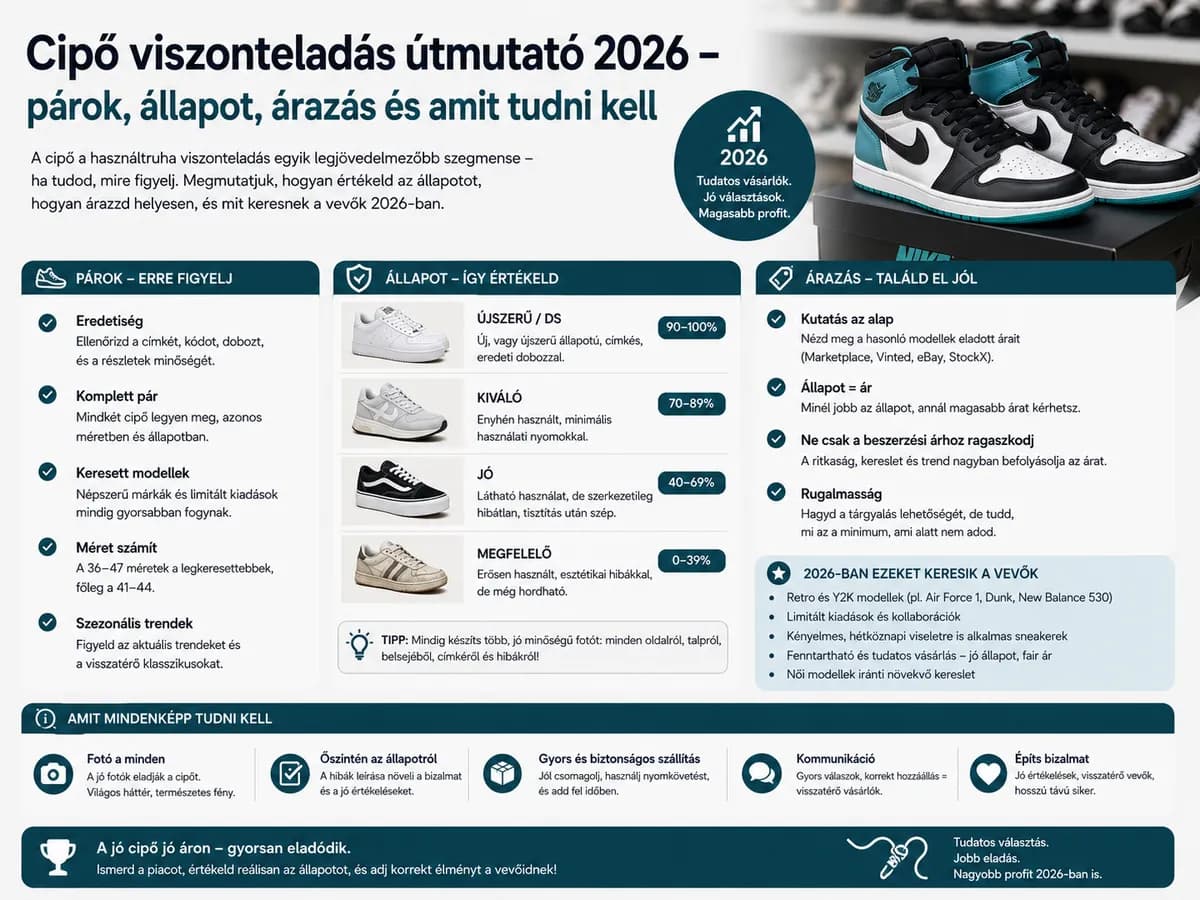
If you've ever sorted through a mixed bale, you've surely noticed: shoes always take the longest to go through. You pick them up, turn them over, check the sole, look for the matching pair. With this instinctive care, you're essentially doing exactly what a professional shoe reseller needs to do – just consciously, with a structured set of criteria.
Shoes operate by a different logic than clothing. A pair of Nike running shoes in good condition can bring 3,000–6,000 HUF on Vinted on their own. It takes just as long to list as a t-shirt, yet generates three times the revenue. At the same time, with the wrong approach – an incomplete pair, wrong size, dirty sole – shoes only bring problems: returns, complaints, negative reviews.
This guide covers how to pick up shoes, how to assess their condition, how to price them, how to photograph them, and how to avoid the most common mistakes. If you're also interested in general pricing logic, read our pricing guide as well – the shoe calculation is built on that foundation.
Shoes cannot be handled the same way as a shirt or a pair of trousers. The physics are different, the logistics are different, and the evaluation criteria are different too. Once you understand this, you already have an advantage over most of the market.
Shoe wholesale bales are generally mixed in composition: different brands, sizes and conditions all end up in one bale. The first and most important rule: check every pair to make sure both shoes are present. This sounds trivial, yet it's the most frequent source of mistakes – during sorting, individual shoes fall out that are worthless on their own.
Size consistency is also a critical point. An EU size 42 left shoe and an EU size 43 right shoe – even if it's the same model – cannot be sold as a pair. The buyer will return it, leave a negative review, and won't buy from you again. That's why you must measure every pair and never rely on visual estimation.
Material quality and wear are immediately visible, unlike a t-shirt where fabric wear only shows up close. With shoes, a buyer can already draw conclusions about condition from the very first photo – that's why photography is especially important. Good photos eliminate most of the buyer's anxiety and speed up the sale.
If there's one thing you take away from this article, let it be this: always look at the sole first. The sole is the shoe's "bonnet" – it shows how much it's been used, how the owner walked in it, and whether the shoe has any life left in it.
Flip the shoe over and look at the sole. Evenly worn soles indicate normal use – that's a good sign. If the wear on one side of the heel is significantly heavier, it may indicate a walking habit or a joint issue. Such shoes need to be priced lower, and the wear must be shown in the photos.
Pay particular attention to the heel rubber: if it's completely worn down and the inner material is visible, the shoe is already at the lower limit of the "acceptable" category, or it's unsellable. The depth of the sole also tells a lot – for running shoes, less than 3 mm of remaining sole thickness is no longer recommended for running, which means a lower price.
The upper of a shoe can be made from three types of material: leather, textile or synthetic. All three age differently and can be cleaned differently.
Leather: minor scratches can be removed with leather conditioner, but deep cuts are permanent. Cracking leather – especially at the toe and heel – is one of the most important value-reducing factors. Textile: generally washable, but stains may remain. Yellowed white textile shoe parts can almost never be restored at home. Synthetic: easiest to clean, but harder to repair if damaged – the edges of synthetic leather can start to peel.
Open the shoe and look inside. The condition of the heel counter and insole is telling: if completely worn down, discoloured and falling apart, this represents an immediate comfort issue for the buyer. A new insole at 300–500 HUF can quickly improve the overall impression.
Lining wear, especially at the heel, is a normal phenomenon – but if the lining has completely deteriorated, it's one of the biggest price-reducing factors. It's also worth making a decision about odour: a strong smell of sweat cannot always be eliminated, and it's worth honestly disclosing this to the buyer.
For zip-up shoes, check that the zip runs smoothly and hasn't been torn from the underlining. For velcro shoes – especially children's shoes – check whether the velcro still grips. If not, the shoe's value drops drastically, unless it's a part that's easy to replace. Also check the condition of buckles and clasps on heels and boots.
| Condition | Characteristics | Pricing |
|---|---|---|
| Like new | Minimal or zero sole wear, flawless upper, clean interior | Full market price |
| Good condition | Slight sole wear, minor scratches, cleanable | Market price −20–30% |
| Acceptable | Visible wear but wearable; minor cosmetic defects | Market price −40–50% |
| Not sellable | Incomplete pair, completely worn sole, torn leather, non-functioning closure | Do not list |
GOLDEN TIP
For washable shoes – trainers, textile sneakers – a thorough machine wash (30°C, gentle cycle) can increase the selling price by 30–50%. The investment is zero, the washing machine does the work. But the effect is dramatic: clean shoes look new in photos.
Wrong size labelling is the most carefully hidden pitfall of shoe reselling. With a t-shirt, the difference between a "large L" and a "small L" is manageable – with shoes, even a half-size difference ends in a return and a negative review. That's why you should never trust visual estimation, and always check the inside of the shoe.
EU size (35–46 adult, 16–35 children): the clearest and the default standard in Hungary. If the shoe has an EU size, this should be listed first. UK size: differs from EU size by approximately 1–1.5 sizes downward (EU 42 ≈ UK 8). British brands – Clarks, Dr. Martens – use this as the primary marking. US size: differs between men's and women's! This is one of the most frequent sources of confusion. A US 8 men's shoe is EU 41, but a US 8 women's shoe is only EU 38–39.
| EU | UK | US men | US women |
|---|---|---|---|
| 36 | 3.5 | 4 | 5.5 |
| 37 | 4 | 4.5 | 6.5 |
| 38 | 5 | 5.5 | 7.5 |
| 39 | 6 | 6.5 | 8.5 |
| 40 | 6.5 | 7 | 9 |
| 41 | 7 | 8 | 10 |
| 42 | 8 | 8.5 | – |
| 43 | 9 | 9.5 | – |
| 44 | 9.5 | 10.5 | – |
TIP
If the inner size label has worn off, measure the insole length in centimetres. To calculate EU size: insole length (mm) / 6.67 ≈ EU size. For example: 265 mm insole → 265 / 6.67 ≈ EU 40. Print out such a conversion table and keep it above your sorting table.
Not all shoes are equal – neither in terms of saleability nor potential price. The following categories are based on 2026 Vinted market prices and help you determine what to focus on when buying wholesale.
| Category | Average Vinted price (pair) | Notes |
|---|---|---|
| Trainers / sneakers | 2,000–8,000 HUF | Most sought-after category, Nike/Adidas stand out |
| Dress leather shoes, Oxford | 1,500–5,000 HUF | Stable demand, brand matters |
| Boots, hiking shoes | 2,000–6,000 HUF | Especially sought-after in winter season |
| Tall boots (winter / riding) | 1,500–4,000 HUF | Strong seasonality, fast from September |
| Sandals, flip-flops | 500–2,000 HUF | Most difficult category, short season |
| Heels, occasion shoes | 800–3,000 HUF | Particularly sensitive to size and condition |
The prices in the table apply to shoes in good condition. If the condition is worse, reduce prices by 30–50%. If the shoe is "like new" and a sought-after brand, you can list it above the upper limit – but keep in mind that buyers on Vinted compare prices, and an unrealistic listing price will deter them.
The brand name is one of the strongest value-adding factors for shoes. Buyers often search by brand on Vinted – so if the brand name is missing from your listing, you'll be invisible in all those brand-specific searches.
TIP
Always put the brand in the first line of your Vinted listing – the title and the beginning of the description are what the search algorithm indexes first and what the buyer reads first. For example: "Nike Air Max 270 – EU 42 – good condition – sole photo included" performs far better than "Trainers for sale size 42".
Photographing shoes is one of the most critical steps – and not by accident. The buyer cannot hold the item in their hands, so the photo is their only tool for making a decision. If the photo is incomplete, badly angled or dark, the buyer moves on. If it's detailed and clear, the buyer purchases with confidence.
EXTRA TIP
Photograph against a white or light grey background – a simple sheet of paper or light wood floor works fine. Never stack 3 shoes on top of each other in the photo, as it looks messy and amateurish. Shoot in natural light (near a window) and turn off the flash, which creates harsh shadows and makes the image look cheap.
Cleaning shoes is one of the most rewarding investments in reselling. With 10–20 minutes of work you can achieve a 500–2,000 HUF higher price – and the proportion of items sold also increases, because clean shoes are far more appealing in photos.
Trainers, textile sneakers: a shoe brush or toothbrush plus a damp cloth is the first step. If heavily soiled, hand wash in lukewarm water or use a gentle machine programme (30°C, works even without a shoe bag). Remove the laces and wash them separately. Dry naturally – not in a dryer, as heat can deform the shoe.
Leather and faux leather: wipe off dust and dirt with a damp cloth. Then treat with a leather conditioner (e.g. Kiwi or similar) – this restores the shine and removes minor scratches. 15 minutes of work can visually "revive" the shoe.
What's generally not worth it: dry cleaning. Dry cleaning a pair of shoes costs around 1,500–3,000 HUF – this is only worth it for high-market-value items (e.g. genuine leather boots, luxury brands). For most average shoes, the dry cleaning cost exceeds the price increase it achieves.
TIP – LACE REPLACEMENT
Replacing discoloured, frayed laces is one of the best micro-investments: a pair of laces costs 300–500 HUF, and visually completely transforms the shoe. New white laces on white trainers can raise the achievable selling price by as much as 1,000 HUF – a 200–300% return on investment.
Experienced resellers recognise these mistakes even in hindsight. If you're just starting out, learn from others' experience – not your own.
If all of this feels like a lot at once, don't worry – shoe reselling is learnable, and experience comes quickly. If you haven't started your business yet, read our business start-up guide as well, where we walk you through the process from the very beginning. In our article on online platforms you'll find out which platform is best for selling shoes – because it matters. You can find our full range here, where shoe bales are available alongside clothing and mixed bales.
Browse our current shoe selection – sorted and mixed bales are available in various categories and price ranges.
Browse our shoe selection →Have a question before ordering? Get in touch with us!